Every Day is a Gift

A dear friend of mine died four weeks ago. It was sudden. Unexpected. There has been no gathering of those of us who loved him, no collective mourning. Even in ordinary times the sudden death of one dear to us is surreal, we keep expecting the news to be wrong, our loved one to be back. I keep thinking of things I should tell him. I hope for collective mourning, sometime in the unknowable future.

I last spoke with my friend in early April. It was a beautiful day, so I walked in my garden while we spoke. It was so good to hear his voice, his laugh, to know he was alright.  We decided to speak every few weeks while this plague is upon all of us. And now he is gone.

We met, improbably, in the Minnesota All State Lutheran Choir in 1977. He was such a talented pianist, such a gifted person,such a beautiful friend. We were friends through all the trials of young adulthood. We stayed friends through all the twists and turns of adult life.

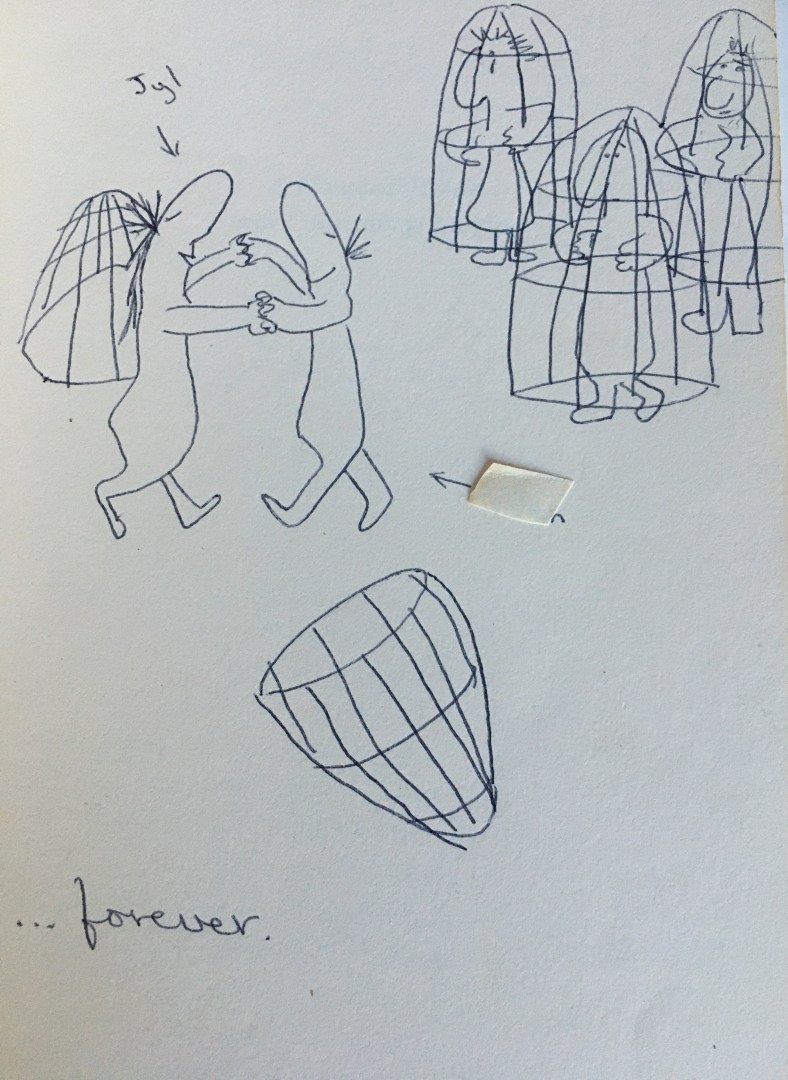
My friend loved Virginia Woolf, and the illustration below is from a book of her short stories that he gave me, after we had both survived many things and come back to embracing life. Free from our cages. Through all those years of friendship, he reminded me that every day is a gift. If we have found our way to be free from our cages, we might as well dance.

Every day is a gift.

2020-05-26 18.48.44


Money does matter

We invest public resources into the education of the public for the benefit of the public. (Bruce Baker, Educational Inequality and School Finance, 2018, p. 18).

Two key points: in public school funding, money matters, and cuts cause harm.

How much money a school system has available, as well as how that money is spent, make a big difference in the experiences kids have in school, whether their educational needs are met, and whether they go on to flourish in their adult lives. This seems like a common sense statement regarding U.S. public schools.

Yet for decades there has been an active campaign to claim the opposite. While the main point of Bruce Baker’s book is to argue how to think about and analyze school finance systems, Baker devotes his third chapter to discussing and debunking this misleading literature. If you are inclined to believe that money doesn’t matter, I urge you to read at least that chapter, or this report, which discusses some of the same sets of arguments.

Baker is careful in the language he uses to critique these studies, but honestly, how seriously can one take a study (for example) that assumes that all state court orders on education funding led directly to appropriations by state legislatures fulfilling those orders? Researchers just made this assumption, and did not bother to collect any information about actual appropriations and implementation, and claimed that court orders didn’t matter. This assumption flies in the face of American history. The history of New Jersey is a history of court orders ignored and resisted, and only slowly and grudgingly implemented, with ample backsliding in economic downturns. Nationwide this is more the rule than the exception.

Indeed, the New Jersey state aid formula that the legislature itself adopted in 2008 has been underfunded by the state legislature basically since it was adopted; see this coverage from 2015. Yes, that shortage from four years ago is more than one billion dollars. This year’s state budget proposes to increase school funding by about $200 million dollars, which is an improvement, but still means that the state is not fulfilling its own promises. (To see more details for Jersey City, check out Civic Parent’s analysis and visualizations.)

I don’t study education policy, but the arc of the argument that money doesn’t matter is very familiar to me from the literature on gender, race, and social policy in the U.S. Baker talks about the persistent but false narrative that U.S. public schools have bloated costs and have shown no progress on student achievement. Just like the false, racist, and intentionally misleading story of the “welfare queen”, this education policy narrative persists despite clear evidence to the contrary. The narrative serves the same purpose: discrediting public goods, in this case public schools, and indeed the very idea of a common public life. And it hurts our kids.

But it is more pernicious and counter-intuitive than that, because schools in the United States have always been unequal in their access to resources, and until Brown v. Board this was official, legal and legally and violently enforced public policy. This argument that money doesn’t matter is based on an ideology that some kids don’t matter, or at least that some kids in some schools matter more than other kids in other schools. In case it wasn’t clear, this is an anti-democratic ideology.

In Other People’s Children, Deborah Yaffe mentions an encounter between two New Jersey school board members, one a white man from Westfield, one an African-American man from Paterson, brought together in a meeting not long after the first Robinson v. Cahill ruling in 1972. Yaffe reports that the white school board member had this question for his counterpart in Paterson: “‘Why are you people making such a big deal out of money? After all, your kids don’t need what my kids need.'” (Yaffe p. 33). Again, in case it wasn’t clear, this is not just racist, it is factually incorrect and also anti-democratic.

Reading this made me think of this point, made years ago by leaders in WTOS, the west Texas IAF affiliate organization. These leaders described the first time they tried to get the city of Lubbock to do something for their majority Latino neighborhood–this was before WTOS was organized–and went to a city council meeting to testify, only to be told “there’s no money”. As they left the meeting, a city employee followed them out, to tell them, “Don’t give up, keep asking. What they are saying is that there is no money for you. Keep coming back. There is money.”

Money matters. It matters for kids whether their schools have adequate funding. And while the New Jersey state funding mechanisms after the Abbott v. Burke decisions began to actually be implemented is actually one of the better state school finance systems according to Baker, he notes that the actual appropriations from the state started to decline around 2005, even before the recession, and the adoption of SFRA in 2008 (pp. 112-113 and see this report).

A second point: cuts matter. Social scientists often look for “natural experiments”, and the recession of 2008 and subsequent cuts to education funding throughout the U.S., unfortunately for kids, provide such a phenomenon. Did cuts to state and local spending on education as a result of the recession cause changes in student outcomes? Kenneth Shores and Matthew Steinberg have analyzed the effects of the recession on a variety of education finance and equity outcomes, including student achievement. The recession had a negative effect on student achievement, and had the largest effect in districts with the largest cuts to school personnel. Cuts have negative effects on kids. Again, this seems like a common sense conclusion, one that we could see just by talking to middle school students in Jersey City, who had their sports budget completely eliminated last fall. But in case you trust social scientists more than kids, there is your evidence.

Kids need schools that have enough funding to meet their educational needs. Money matters. Our promises to our kids matter. Our democratic public life matters. School funding cuts in districts where school funding is already inadequate hurt kids.

Let’s try to keep at least some of our promises to our kids. All of us will benefit.


Public schools are public goods

Parent leaders in Jersey City Together are consistently saying this in our public conversations: public schools are a public good. This essay is inspired both by their consistent leadership in making this point, and our shared frustration that we must keep making this point; that is, that it is not already a common public understanding that public schools are a public good in democratic public life:

Almost never is there an expressed concern about the public realm; there is silence about renewing the common world and about what that common world should be. What is it that lies in between, that holds us together, that we can cherish and try to keep alive? Where, when we ponder it, are we to turn? Questions like these move me to explore the role that might be played by public education in bringing into being an authentic public space, one that might give rise to a significant common world. Maxine Greene, 1982.

I recently came across the address given by the late Maxine Greene in 1982 when she served as president of the American Educational Research Association. The title is “Public Education and the Public Space,” and she speaks of the possibilities that are part of the purpose of education: “…we are educators, and education has to do with new beginnings and with reaching toward what is not yet.”

Greene speaks of what is missing in the conversation about public education in the 1980s, and it is equally true today. Discussions of funding formulas and graduation rates are important, but frequently these conversations divert our attention from any focus on the public purposes of public schools. Greene is speaking to educators, but she is also speaking at a time when the movement for our current regime of testing as accountability was on the rise. Just before the passage quoted above, she says, “literacy is talked about as though it were part of the gross national product.” What about the intrinsic joy of reading? What about the democratic civic purposes of an educated public?

We have become accustomed to speaking of schools in terms of achievements on tests, graduation and drop out rates, per pupil spending. Even Dennis Shirley, in his (very useful) discussion of the Alliance Schools program in Texas, speaks of test scores as one measure of the success of this community school program. All of these are important. But they are not all of what public schools are or can be.

Public schools serve public purposes for democracies. This is a simple, straightforward, necessary idea. This is not a new or original idea. But it is crucial.


In an article on the growing number of teacher strikes last year, Sarah Jones argued that one of the reasons for these strikes and for the conflicts over public schools more generally is that public schools “are some of the last public squares in this country”. Discussing the requirements in U.S. state constitutions for public education, she notes that three common words that describe public education are “Free, common, and efficient. These words tell us that public schools should be accessible and ubiquitous, and that they should function. ”

Yes. Public schools should function. They should help children to develop their human potential. They should provide appropriate, supportive environments for all students to learn. They should have space to play, to create, to imagine. These things are happening every day in Jersey City Public Schools. But there are many, many challenges as well.

In order for public schools to function, school facilities need to function. Public schools should not have classrooms that are dangerously hot or cold, that are infested with cockroaches, that are falling apart. They should have potable drinking water. They should have functioning bathrooms. That we are fighting for these very basic, functional facilities in Jersey City is shameful.

The story of why this is so is long and complicated, of course, implicating state as well as local officials and the failure to fully fund the School Development Authority despite the Abbott court’s order. Some beautiful schools have been built in Jersey  City.  But funds for repairing our ageing schools have not been appropriated. And the lesson of who is valued, and who is not, is starkly clear to young people in Jersey City. We have beautiful, new high rises, and crumbling high school facilities.

Greene goes on to cite Dewey, and his notion of the “eclipse of the public” articulated in The Public and its Problems (originally published in 1927). The persistence of this concern tells us that we should resist the temptation to refer to some nonexistent golden age; attention to the public realm and to public things is one of the key ongoing problems of democratic public life. Civic life requires us to be engaged in the ongoing project of renewing the democratic public realm. We have to organize.

At the end of Deborah Yaffe’s book Other People’s Children, about the long effort by the state of New Jersey to refuse to provide a thorough and efficient education to all of the children in the state, despite decades of court orders to do so, she notes that she is often asked “did it work”? People mean different things by that question, and one of the problems with answering it is that in some arenas, the state never did really comply with the court orders. But at the very end of the book, she makes reference to the public purposes of public schools, quoting one of the named litigants in the Abbott cases, Hector Figueroa. “‘You’re not guaranteed a home life, but you should be guaranteed a school life.'” And Yaffe says, “Public institutions matter, even if they are not the only things that do.”

Public schools matter. We must create more possibilities for schools to be the kinds of public spaces that are so vital to democracy. We have to dare to try.

You don’t have to watch

I was in graduate school when Clarence Thomas was nominated to serve on the Supreme Court. To remember that the Justice who had retired was Thurgood Marshall is to remember what an insult to everyone’s intelligence it was when George H.W. Bush stated that Thomas was the most qualified person to fill the vacancy.

After Anita Hill came forward, and the all white all male Senate Judiciary Committee determined that there would be hearings, and they would be publicly broadcast, some of my colleagues in the political science PhD program arranged for the broadcast to be available in their department office, and invited other graduate students to join. Yes, they organized a “watch party”. So that they could watch the spectacle, which had the foregone conclusion that Anita Hill would be treated in the dreadful way that she was treated, and Clarence Thomas would still be confirmed.

The main person organizing this “watch party” was one of the most egregious misogynists in the program, a serial sexual harasser and obnoxious anti-feminist, darling of the “both sides” faculty who were happy to consider the possibility, in the purely philosophical terms of graduate seminars, of course, that only white heterosexual men counted as human.

I did not attend. Our friend the notorious misogynist urged me to attend, expressing shock that an avowed feminist had no intention of watching the hearings. Because the whole point was to use this “watch party” to assert and reinforce white male power, and make the women graduate students participate in the process. Just as this was the whole point of the 1991 hearings. And it is the whole point of the current process as well.

Professor Hill is correct that in 2018, it would be possible to have learned from the past and changed, but as Andrea Grimes has so clearly written, the whole point of the current leadership is to assert and consolidate conservative white male power.  The majority leader, ever since his refusal to hold hearings or even meet with Merrick Garland, has demonstrated that he will use his power by whatever means necessary to accomplish his goals. If we want that to change, we have to out organize them, and watching their pre-baked spectacle won’t move that organizing forward. So use your anger to organize and build enough power so that they won’t have the votes to do this next time.

I have just experienced an effort to re-center white heterosexual male power as the only legitimate power at a micro level in the workplace once again for the millionth time. So no, I will not be watching the hearings; I have seen this spectacle many times. I have many ideas about more productive ways to use my time to bring about actual change, and I plan to implement some of them tomorrow. I urge you to consider doing the same.

Living democracy

“The history of American democracy, like the history of democracy everywhere, is a history of contestation of political authority, and of the democratization of this authority, by legal changes that are powered by social movements and by forms of contentious politics that indeed at certain moments in our history have either pressed the limits of nonviolence or even exceeded those limits, typically in response to the violence of the state.” Jeffrey Isaac

In a recent post on the Public Seminar site, Jeff Isaac reminds us that it might be a good time to pay attention to how democracies live. And a living democracy is never finished; that is indeed a key point of democratic politics. As Isaac points out, democracy depends upon agreement on norms, and also quite crucially depends upon challenges to those norms. Challenges to norms by the failure of elites to comply with democratic norms, however, is a very different matter than the challenges to norms by people who have been harmed and excluded by elite dominance of political processes.

How do democracies live? In a way this is what the point of democratic political theory ought to be, although much of the genre exists at the margins of this question. It is important to remember that free and fair elections and universal access to the vote are a minimum requirement for democracies to live. Elections are not the entire substance of public life.

Charles Tilly notes right at the outset of his book, Democracy (2007), that he could not give it the title that would accurately describe his argument:  “Democracy, Democratization, De-Democratization, and their Interdependence”. But this is a key argument of the book: a living democracy is never completely secured from the processes and interests that work against democratic practice, nor could it be. And sometimes democratization requires violation of existing norms.

Since the beginning of 2017, a group of political scientists has been conducting polling on perceptions of experts and the public on processes of democratization and de-democratization in the U.S. Bright Line Watch is an example of the recognition that democracy is a process, and as Tilly argues, processes of de-democratization can occur even in the most established regimes. The results indicate that those worried about democracy in the U.S. have good reasons for concern. But it is also true that many of these process have been underway for a much longer time frame than the past year; indeed if Tilly is correct they are always underway.

Democracies require public work, as Nanci Kari and Harry Boyte argued almost thirty years ago. Politics is always a question of reflection and of action, of what, given our present context, we should do. And what we should do is not confined to electoral politics, or defined or made necessary only by the existence of a particular political leader.

We are seeing right at this moment inspiring leadership, public work, of young people in response to violence that, if not sponsored directly by the state, is broadly permitted by government policies that serve both corporate interests and a form of white nationalist identity politics. We need this public work, even if it is not “successful” in the sense of bringing about specific changes in national politics or policy. It is also difficult to see how this leadership could be taking place without the context of the Black Lives Matter movement, a youth-led movement against violence committed by the state. Black Lives Matter is an inspiring and a crucial form of public work for our time.

We also need the ongoing work of groups such as the “Black Mama’s Bailout Action” led by Southerners on New Ground (SONG) last May. SONG and other groups work against the ongoing racialized state violence of mass incarceration. Those who study social movements know that the ongoing, on the ground organizing of many groups makes it possible for political change to happen, incrementally as well as at moments when there is a shift in the political context, providing an opening for changes in democratic practice. This ongoing work is one part of how democracies live.

Our common humanity

“The moral consensus of a free state is not something mysteriously prior to or above politics: it is the activity (the civilizing activity) of politics itself.” Bernard Crick, In Defense of Politics

Bernard Crick argued in defense of politics as an activity, as something that we do together. But he notes in the paragraph that precedes the above sentence that for people to engage in problem solving through politics, they must first have “a common interest in sheer survival”. To see our common interest, we must see our common humanity.

During the “debate”, if it can be called that, over the unsuccesful attempt to repeal the Affordable Care Act in 2017, I kept wondering, what, exactly, do people think insurance is? The whole concept is about collective risk. It is difficult to purchase fire insurance for your home after your home has already caught on fire. The idea that health insurance is only for people who are “sick” is just empirically false. Some of us, perhaps those of us able to read and write at this moment, enjoy temporary good health. Eventually all of us die. In the process, we are all likely to need some kind of medical care. And none of us would survive to adulthood without the care provided by other people.

Political theory can be very useful for thinking about these kinds of questions, and in this case we can turn to Joan Tronto. She has thought very carefully, over several decades, about the relationship between care and political life.  In doing so, she has thought about the complexity of the ways that care and inequalities are reproduced particularly in the contemporary United States.

What does care have to do with insurance and collective risk? Tronto argues that the traditional way that liberal democratic political theory has thought about humans in political life–as independent, unencumbered individual utility maximizers–gets just about everything wrong. This notion is wrong about being human, it is wrong about the substance of political life, it is wrong about democracy, and it is wrong about how to live a meaningful life. And this notion certainly misleads us about the challenges of the present political moment.

Of course many political theorists have made this argument. But Tronto argues that it is much more useful for those of us who care about democracy to think of humans as care receivers. “Dependence marks the human condition from birth until death.” (Caring Democracyp. 94)

In the debate over the ACA, the claim was made that it was “unfair” for healthy people to pay for sick people. As if there is such a thing as “healthy people” and “sick people” as a kind of ontology. No. There are people. And it bears repeating: none of us would survive to speak or write or complain about paying for insurance if we had not already been care receivers.

Tronto would argue that those who see themselves as healthy people are claiming a kind of “pass” out of responsibility for others. But her claim goes even deeper: they are claiming immunity from human vulnerability. They are claiming not to be human.

There are no healthy people, only people temporarily enjoying good health.  “We are care receivers, all.” (p. 146) As the twitter hashtag had it, #iamapreexistingcondition.

Sooner or later, we all need health care. We are human.  We are vulnerable.

Perhaps that is just too frightening for some to recognize. But if we are to have a better politics, we need to start with our common interest and our common humanity.

We are all deserving

We live in a political time in U.S. politics where public officials propose non-solutions to non-problems (a border wall is a good example), while actively working to make real public problems worse (failing to renew CHIP funding is a good example).

Meanwhile the idea that the purpose of political life is to solve collective problems of the body politic seems to have vanished.  Well, not vanished.  But it is hard to find in the midst of all the shouting.

I wrote a book about citizenship.  It’s about sexual citizenship, so you might have missed the citizenship part, what with the sexual part, but I argued, following a number of smart scholars, that all citizenship is sexual citizenship.

The book focuses on specific policies that engage in sexual regulation.  These policies were also intended not to solve actual public problems, but to reinforce and valorize powerful political entrepreneurs’ and public officials’ ideas about families and family life. The policies especially serve to distinguish between those who are deserving as citizens, and those who are not. Each of the policies–the 1996 welfare law, abstinence-only sex education, DOMA–target specific groups for punishment. Each of these policies was a non-solution to a non-problem.

Reality is more complex.  Usually, simple solutions to complex public problems are not very effective.

Then, there are times when simple solutions really might work-like giving people who don’t have enough more: more money, more food, more shelter, more education funding, more medical care-but we find lots of reasons not to use these simple solutions.

The mechanism for deciding who is deserving is an ideal form of family-in the book I call it the “white hegemonic heteronormative family ideal”, a mouthful to be sure-is sexuality and sexual “responsibility”. But certain groups, by nature of their very identity, their very being, are by definition not deserving. Thus we find reasons to punish these groups, rather than to give people what they need.

Once your book is published, you don’t expect it to become more relevant or timely, but it seems to me that the points that many scholars have made, and that I make about deservingness and inclusion, are becoming more and more relevant. The circle of the deserving is narrowing, and the circle of the undeserving has broadened to include just about all of us.

This is surely a sign that we need a better politics.  But that politics won’t just appear:  we have to fight for it. We have to, along with our neighbors, build the power to create a better politics.  It has to be a politics where all of us have the ability to be human, to act as members of the polity, together. And where we are all deserving.